Peter Style (Project Manager), University of Manchester
Information
Many children in the UK suffer with significant bladder problems that result in bed-wetting, incontinence, urine infections and even severe kidney damage. In fact, rare bladder conditions are the commonest cause of kidney failure in children who can only be kept alive by dialysis and transplantation. Up to one in three children with severe bladder emptying problems also have constipation. Bowel and bladder problems have more impact than almost any other medical condition on children’s self-esteem, education and social relationships.
Genes are the inherited instructions in our cells providing the information for how our bodies develop. We know that many genes are important in how the bladder and ureters (tubes connected to the kidneys) develop and work. We have discovered changes in a number of these genes in children with rare severe bladder problems. However, we have collected samples and clinical information from many children where we still do not have a genetic answer. This represents a significant unmet need. Through this rare disease node we will create a network of clinicians and researchers across the UK to collect samples and information from children affected by these conditions creating a registry of affected individuals and genetic samples for further study. We will work as a collaborative team to address these challenging problems and train and support the next generation of researchers and clinicians to care for affected families.
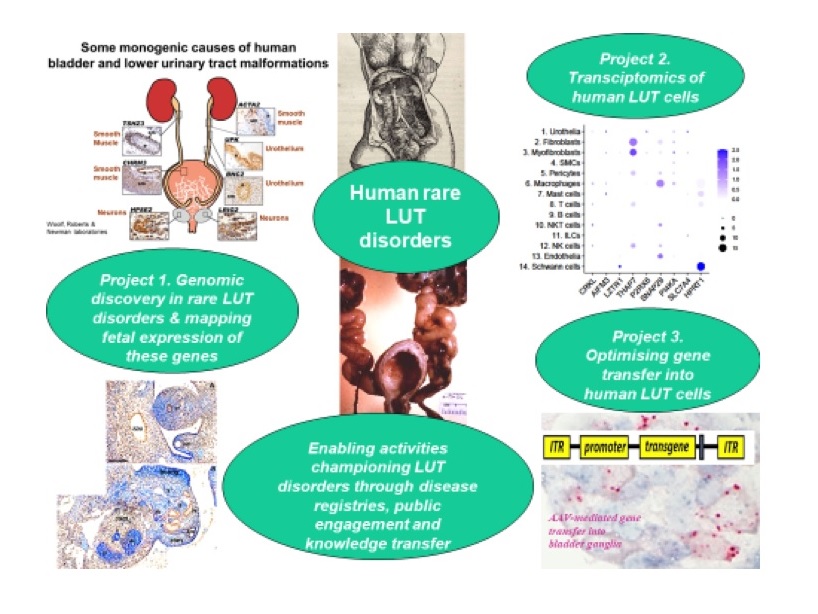
We propose 1. to use new types of genetic analysis to find the causes of severe inherited bladder problems; 2. to look at how genes are switched on and off in the bladder and ureters in children with a severe condition called bladder exstrophy from samples taken at surgery and compare these patterns to healthy children. This will give us an insight into how the organs develop and how and why this may go wrong; and 3. we will look at new and exciting ways to deliver genes to the body so that they may correct these conditions using an approach called gene therapy.
Finding the responsible genes will allow us to: 1. give families the reason for their children’s problems; 2. do simple genetic tests on other family members to see if they may require check-ups to detect and prevent future problems; and 3. start to develop novel treatments.
Objectives
We will create a vibrant interactive network of researcher, clinician and patient advocacy groups focused on improving the diagnosis and care of patients with rare early onset lower urinary tract disorders.
We will form a virtual centre of excellence to train and support the next cadre of health professionals and researchers in disorders of the lower urinary tract. The network will ensure that all families affected by rare inherited disorders of the lower urinary tract (LUT) have an opportunity to participate in, and benefit from, our research.
The REOLUT node has three specific Projects:
Genomic discoveries in rare LUT disorders
Transcriptomics of human LUT cells focused on bladder exstrophy
Bill Newman has three decade’s experience in clinical genetics. He has led over 25 rare inherited disease gene discoveries, coupling these with functional studies defining molecular pathways and treatment targets. These include REOLUT disorders such as urofacial and prune belly syndromes and bladder exstrophy. In 2013 he assumed the Chair in Translational Genomic Medicine at the Manchester Centre for Genomic Medicine, and in 2014 he became Director of Greater Manchester Genomic Medicine Centre for the 100,000 Genomes Project. He is the Clinical Director for the North West Genomic Medicine Service Alliance. In 2021 he established the Manchester Centre for Rare Conditions and in 2022 led a successful application for a NIHR BRC theme in Rare Conditions.