Peter Style (Project Manager), University of Manchester
Information
The studies of how genes are switched on and off in cells in our bodies are called Epigenomics and epigenetics. The EpiGenRare node will coordinate research in epigenomics of rare diseases. This is important because more than 100 rare epigenetic diseases are known, and all together they represent a large number of patients with rare diseases. Epigenetic diseases remain challenging to discover, diagnose, understand and treat. In addition to this, epigenomic studies that investigate changes across all of the DNA in patients, could have an impact on rare diseases that are not traditionally seen as epigenetic diseases.
The node team is made up of experts in relevant disciplines, industry, and patient support groups and has institutions across the UK and investigators at different career stages. Our team builds on substantial existing infrastructure, funding and track records that will enable us to tackle the challenges in the area.
In our networking activities we will undertake a scoping survey to generate a list of individuals and institutions relevant for this area of research and invite them to be members of EpiGenRare. We will then host a variety of events including conferences and educational sessions over the course of the next 5 years where epigenomics will be the focus of the events.
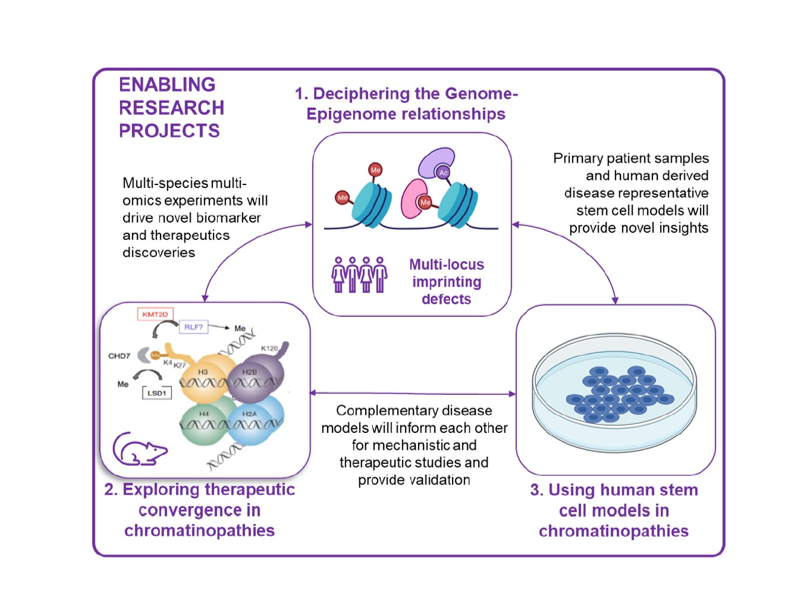
We plan to do three projects: (1) To generate a resource linking patients’ genomic and epigenomic data which can be used by other researchers. (2) To perform preliminary studies in animal models to test if similar treatment approach could be used for multiple epigenetic diseases that share clinical features and biological mechanisms. (3) Generate a resource of well-studied human cell models for large scale drug testing in epigenetic diseases. Additionally, we have put in place ideas for future projects with our collaborators and several other nodes in the UK Rare Disease Platform.
As part of our patient and public involvement (PPI) program we will continue to work with various relevant patient-family support groups. Patient support groups will be part of the advisory board and will participate in driving the networking activities and the research and collaboration agenda. With patient support groups we will co-develop patient information resources, organise family education days and work together to develop evidence-based management guidelines for epigenetic disorders.
The EpiGenRare node will help address several unmet needs and will allow us to accelerate diagnoses and treatments for epigenetic disorders.
Objectives
The aims of EpiGenRare are:
To develop, validate and use multi-omic approaches to enable accurate diagnosis and identification of predictive biomarkers for rare epigenetic disorders;
To identify groups of rare diseases with common or convergent epigenetic mechanisms and develop and test therapeutic strategies to target these mechanisms in order to dramatically reduce complexity and the number of targeted therapies required to treat these diseases;
To develop approaches to combine and integrate data from different model systems of the same rare diseases, notably human pluripotent cell-based models and genetically modified mouse models to identify the most appropriate models for pre-clinical studies.
Albert Basson is Professor of Neuroscience and Epigenetics at the University of Exeter. Prior to joining Exeter, he was Professor of Developmental Neurobiology in the Centre for Craniofacial and Regenerative Biology and the MRC Centre for Neurodevelopmental Disorders at King’s College London. Research in his laboratory has provided insights into the mechanisms responsible for developmental birth defects, syndromes and neurodevelopmental disorders. His research programme aims to understand how dysregulation of the epigenome affects the development and function of the brain. His group studies a number of rare genetic disorders caused by mutations in genes that encode chromatin regulators and seek to understand how epigenomic changes cause age-associated cognitive decline. Their long-term goals are to provide fundamental insights into the epigenetic mechanisms that underlie neurodevelopmental disorders and cognitive decline and to determine if targeting these mechanisms can provide novel therapeutic possibilities. He is passionate about engaging with patients and families affected by rare disorders and is a member of the professional advisory board of the CHARGE syndrome foundation.
Professor Siddharth Banka
Sid Banka is a Professor of Genomic Medicine and Rare Diseases at the University of Manchester, a Consultant Clinical Geneticist at St. Mary’s Hospital, and the Founding Clinical Director for the recently established Manchester Rare Conditions Centre. He is a Clinician Scientist whose research focusses on developmental and congenital malformation disorders. His research group consists of clinicians, bioinformaticians and fundamental scientists. He has led the identification of >25 novel genetic diseases, including several chromatinopathies. His group uses patient-derived materials and cellular models to uncover the pathophysiology of rare disorders to identify potential treatment targets. He is also conducting clinical trials for potential therapies for rare chromatinopathies. He has developed several national clinics for chromatinopathies, is closely associated with patients support groups of several epigenetic conditions and is experienced in organising complex networking and co-ordination activities.