
Embedding PPIE in statistical methodology research for rare diseases
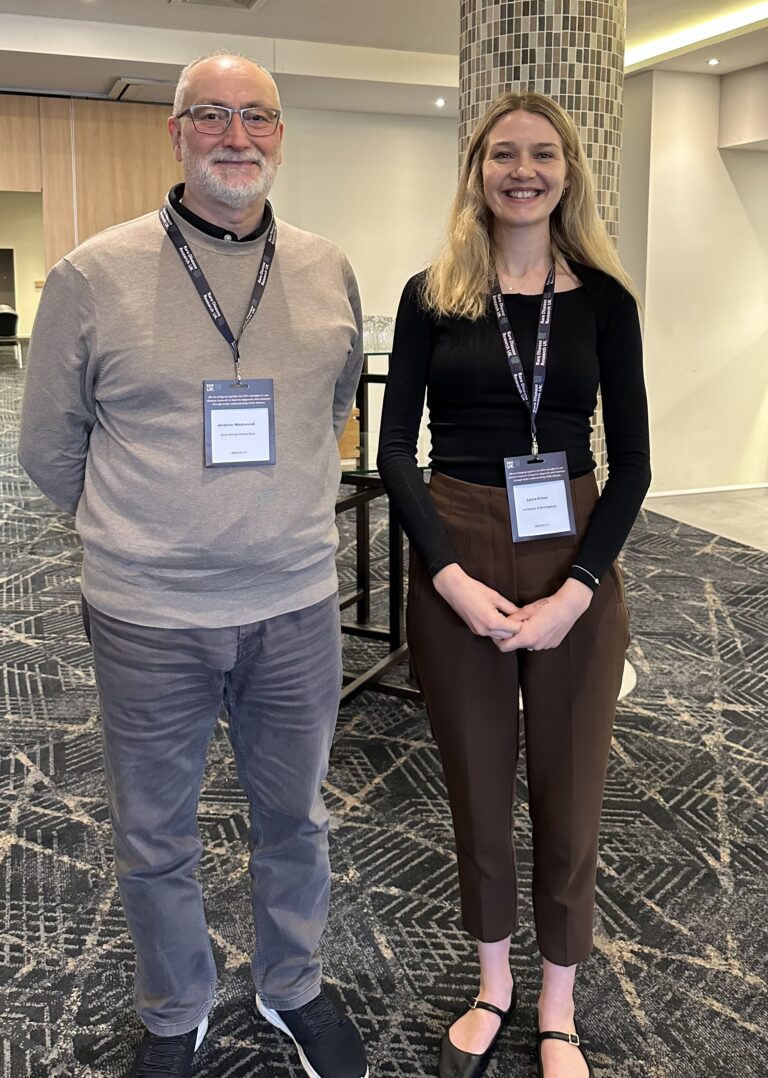
Laura Kirton and Andrew Westwood
Laura Kirton and is a Senior Biostatistician at the Cancer Research UK Clinical Trials Unit (CRCTU), University of Birmingham, and an NIHR Doctoral Research Fellow. She is completing a PhD part‑time through the Doctoral Fellowship scheme alongside her role at the CRCTU, where she works primarily as a statistician on Ewing sarcoma clinical trials. Laura works closely with a patient advocate, Andrew Westwood, a parent of a Ewing sarcoma patient survivor, for both her clinical trial research and PhD.
How our PPIE journey started
Looking back, it makes sense that PPIE has become central to my work, even if it wasn’t something I consciously set out to focus on. Building a career in medical statistics at the Cancer Research UK Clinical Trials Unit (CRCTU) as a trial statistician, focusing on identifying the best way to treat patients, has meant I’ve been fortunate to work alongside amazing patient advocates from early on.
When I applied for my NIHR Doctoral Fellowship to undertake a PhD, I was aware that PPIE was a core component, but as a statistician, this was not something I had previous experience in for methodology research (i.e., research focused on developing the “how” of research). While it was easy to see how PPIE fit within clinical trials, I was less sure how it applied to statistical methodology, given its mathematical and abstract nature, and how clearly it would connect to real‑world outcomes.
Therefore, as part of the fellowship application, I set up an initial meeting with Ewing sarcoma patient advocates, recruited through my CRCTU connections, and established networks and charities including the Euro Ewing Consortium (EEC) and the Bone Cancer Research Trust (BCRT). That first meeting was a real turning point. The level of engagement and interest made it immediately clear that PPIE wasn’t something I would need to force into my PhD; rather, it would fit naturally. Seeing how readily people connected with the ideas, and how they could see the downstream impact, helped ground and shape my work.
Where PPIE fits within the research
My Doctoral Fellowship focuses on developing methods for clinical prediction tools in rare diseases, with a particular focus on Ewing sarcoma, an area I already work in at the CRCTU. Ewing sarcoma is a rare, paediatric cancer, occurring most commonly in adolescents, with approximately 90 new diagnoses per year in the UK [1]. Clinical prediction tools aim to predict what might happen to a patient in the future, with these predictions potentially helping doctors to make more personalised treatment decisions. Current statistical methods in this research space are more applicable to more common diseases and need to be adapted for rare diseases.
For the applied parts of the PhD, where prediction tools are developed specifically for Ewing sarcoma patients, PPIE has a clear role (e.g., deciding which patients are considered high-risk based on their prediction). Patients and families are the end users, so their input shapes what information matters, and how findings are interpreted and communicated. Alternatively, in the more methodological chapters, PPIE looks a little different. Rather than focusing on specific tools, discussions are more about priorities: which questions matter most and where methodological developments could have the greatest impact.
The PPIE working group for my PhD is made up of a diverse group of primarily Ewing sarcoma survivors and parents of patients. Through regular PPIE meetings, the group continues to shape the direction and progress of my PhD; the PPIE work has been so substantial that my final chapter will focus on bringing together these contributions and collaborations, integrating the applied, methodological, and reflective elements of the project.
A patient advocate’s perspective
Andrew Westwood – Ewing sarcoma patient advocate
“For me, as a patient advocate and father to a childhood cancer survivor, PPIE is a vital part of a holistic research approach. Yet cancer research is inherently complex and highly scientific—so how can lay people meaningfully contribute among trained specialists?
The answer is – quite naturally – but only because experts like Laura make it so. By explaining statistics and trial design in plain language and using real-life examples, advocates can better understand the field. With permission to ask “silly questions” we move from curiosity to comprehension and gradually help shape solutions. This isn’t about adding emotion to a clinical subject at every turn, but about grounding discussions in lived experience. It allows researchers and advocates to challenge one another constructively, ultimately improving patient outcomes, both in terms of survival and the long-term impact of their treatment pathways.
I cannot overstate the personal impact of being involved in this PPIE work. It offers a meaningful, practical way to contribute to cancer research. More importantly, when advocates are included as partners, the research community can continue building better futures for those who have yet to face these experiences.”
A small example with big impact
One of the most impactful examples of PPIE so far in my PhD came from discussions that, at the time, felt quite small and informal, and what I’ve come to think of as a “nugget of gold”. During our meetings, we talked about how the predicted risk for an individual having an outcome at a future time point (e.g., a progression or death) might be communicated to them in practice, and how important it is not just to present a single number (e.g., “your risk is 20%”), but to be open about the uncertainty around it (e.g., “we think your risk is 20% but it could be somewhere between 10% and 30%”). Given the rare disease setting with small patient numbers (i.e., a small sample size), it is expected that there is likely to be more uncertainty around the estimated predicted risks. However, patient advocates were clear that predictions could still be helpful if they were communicated honestly and transparently, rather than presented as precise or definitive.
That perspective ended up shaping work beyond the PhD itself. These discussions fed directly into a statistical advice paper on how uncertainty should be reported when presenting predicted risks [2]. Embedding PPIE into this work strengthened it in a way we hadn’t initially anticipated. It’s not just statisticians arguing for best practice, it’s informed by the views of the people for whom these predictions are ultimately intended.
“I believe in the old adage, knowledge is power. To make patients aware of the inherent uncertainty in any predictive model is, to my mind, ethically mandatory” – Andrew Westwood (patient advocate)
The paper has already been influential and led to uncertainty of risks being presented for new prediction tools. For me this is a clear example of how PPIE doesn’t just improve individual projects but can ripple out to shape wider research.
A few things I’ve learnt along the way
Doing PPIE has taught me a lot, and I’m still learning. I don’t have all the answers, but I wanted to share a few reflections from my own experience in the hope they might be useful to others starting out.
As a statistician, my work can sometimes feel quite removed from clinical practice. I’ve found that anchoring it in a clear clinical context (like Ewing sarcoma), and being explicit about the downstream impact for patients, makes it much more tangible and easier to discuss. Practically, it’s important to budget for PPIE properly so that patient advocates can be involved throughout the project. Working with charities and organisations in relevant disease areas (e.g., CRCTU, EEC and BCRT) has also been invaluable, not only for recruiting patient advocates, but for the support and shared experience they provide.
Communicating with patient groups is a skill I’m continuously honing. Attending training on how to approach communicating technical research has been really useful. Practice matters just as much. Explaining concepts to people outside my field has helped me adapt my communication style and realise when ideas that make sense to me don’t translate as clearly as I expect. I’ve found visual aids, analogies and plenty of time for preparation particularly useful here.
Finally, I’ve learnt not to underestimate what could come out of open discussion. Having clear aims for a session helps, but some of the most valuable insights (those “nuggets of gold”) come from conversations I hadn’t necessarily planned for.
A final thought to other researchers
PPIE has had a clear and sustained impact on my PhD and Doctoral Fellowship, from securing funding through patient advocate support, to shaping research priorities, methods, dissemination, and future directions. Looking ahead, I aim to develop practical resources to support researchers, particularly statisticians, in involving patient advocates and communicating complex ideas in this area of research.
One of the biggest ways PPIE has shaped me as a researcher is in how I think about relevance and value, particularly in rare disease research. When patient data are limited, patient perspectives become even more important. They help ensure that research questions and the methods used to answer them are focused on what will genuinely be useful, rather than what is simply possible with the data available.
More broadly, I see PPIE as vital to medical research, including both applied and methodology research. It helps keep research grounded, accountable, and connected to the people it is ultimately designed to benefit. For me, involving patient advocates from the outset has helped ensure that limited data are used in the most meaningful way possible. I don’t see PPIE as replacing rigorous methods, but as something that strengthens them, and based on my experience, something that can meaningfully improve research at any stage.