Working together to shape the future of Down Syndrome, Fragile X Syndrome and Williams Syndrome research
Dr Laura Cristescu and Chris McQuade
What happens when people with a genetic syndrome and their families become equal partners in research? How much more meaningful does research become when shaped by lived experience?
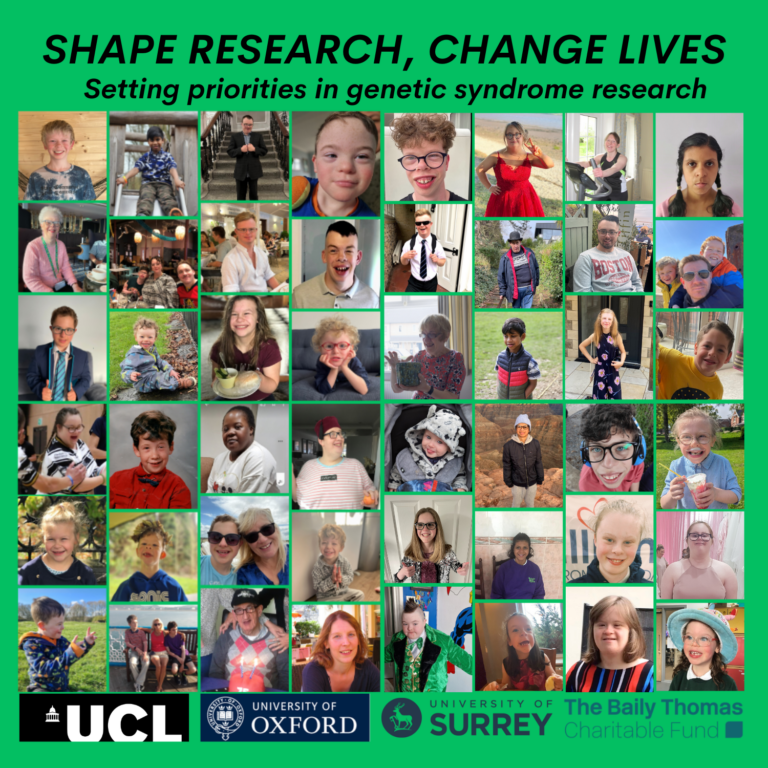
These were the driving questions behind Shape Research, Change Lives, a UK research project conducted at the University of Surrey, in partnership with the University of Oxford and UCL. This project set out to understand the research priorities of the Down syndrome (DS), Fragile X syndrome (FXS) and Williams syndrome (WS) communities.
Research has huge potential to improve daily life. However, the people most impacted by research are rarely involved in deciding what research is carried and how this is conducted. This means that unfortunately, too often research findings can be disconnected from real-world needs and fail to have a meaningful impact on daily life. In order to bridge this research to practice gap, some researchers have started to shift away from doing research “to” or “for” participants, moving towards collaborating “with” communities with lived experience. Shape Research, Change Lives was built on this idea from the very beginning.
Patient and Public Involvement and Engagement (PPIE) is one way of pursuing collaborative research. In our project, this meant developing a partnership between the research team and people with lived experience of DS/FXS/WS (for information about the research team and PPIE collaborators, please visit the project website). We collaborated closely with a steering group and two advisory groups: one made up of young adults with these genetic syndromes, and another of parent/carers. The Steering Group included members from the DS, FXS, and WS communities with lived experience and/or advocacy and/or policy/funding experience. This collaboration was at the heart of the research project, and joint decisions were made at multiple timepoints, including when shaping the study, recruiting participants, conducting the research and sharing its findings.
With invaluable input from our PPIE collaborators, we were able to elicit the views of children with DS/FXS/WS, parent/carers of individuals with DS/FXS/WS, researchers and practitioners. Our PPIE methodology ensured a huge response – close to 500 people shared their priorities for research via focus groups and surveys. What we heard was clear and powerful. There was a mismatch between the current landscape of research on DS, FXS, and WS and the research which the communities with lived experience want to see conducted.
This blog shares the story of how that collaboration unfolded, why it mattered, and how working alongside people with lived experience can help shape research and foster meaningful impact.
At the start of our collaboration, we asked ourselves some important questions: what did everyone need to know before we began, and how could we make sure we shared a clear understanding of the research and its aims?
Our PPIE collaborators were identified in partnership with three charitable organisations representing each genetic syndrome, all led by individuals with lived experience of DS/FXS/WS. Drawing on their deep knowledge of their communities, we worked together to approach individuals who would be interested in contributing, while ensuring that all three syndromes were represented.
Before the collaboration began, we shared accessible information briefs that explained what the research was about, why it mattered, and how it connected to previous research in this area. We were clear about what involvement would look like in practice: how often meetings would take place, how long they would last, how people could contribute, how they would be compensated for their time, and any activities that might take place outside meetings. This was an important step in making sure everyone felt informed and comfortable from the outset.
Our first meetings were about building relationships. Researchers and PPIE collaborators took time to get to know one another, sharing their motivations for being involved, previous experiences of research or similar projects, and their expectations for the work ahead. We talked openly about what a positive experience of collaboration would look like and invited suggestions before any research activities began. We also spent time talking about research itself: what it is, what researchers do, and how this project aimed to make research more relevant to people’s lives. For one Advisory Group member, being part of the project was closely linked to increasing public awareness of their genetic syndrome:
“I like to spread awareness about Williams Syndrome, and I like to make sure that people who are with me on a day-to-day basis know how to communicate with me and how best to help me.”
– (Advisory Group member, adult with WS)
How did we clarify roles and create the conditions for meaningful collaboration?
A core part of working well together was making sure everyone clearly understood their role in the project, and felt confident contributing in ways that worked for them. In our first meeting, we discussed and agreed a set of Terms of Reference which outlined the purposes and vision of the collaboration, the tasks each collaborator would commit to, as well as a clear timeline for meetings. We also agreed practical ways of working together, such as sharing documents at least two weeks ahead of meetings and using structured agendas that clearly set out the timing of each discussion item.
Open dialogue and flexibility were central to the way we worked. We took simple but important steps to make sure every voice could be heard, including ensuring that everyone had equal time and opportunity to speak during meetings. The researchers actively listened to suggestions and implemented them promptly. For example, Advisory Group members, adults with DS/FXS/WS, recommended including regular breaks and activities, and suggested that information should be “broken down rather than having it all said at once”.
We drove the project using simple supporting technology tool, such as a Sharepoint channel, that served information clearly and freely, and ensured we kept communication channels open throughout. We acknowledged members’ communication preferences, allowing for contributions orally and in writing during and after the meetings. The collaboration was a reflexive and iterative process that evolved based on members’ feedback. We shared regular updates on how the research was progressing and, importantly, showed how PPIE collaborators’ ideas and recommendations were shaping the project as it developed.
How was the research shaped through our collaboration?
Our PPIE collaborators played an active role in shaping the research at every stage, from data collection to analysis and sharing the findings. The project’s name Shape Research, Change Lives emerged by combining the suggestions of Advisory Group members, reflecting both the purpose of the work and the values behind it. PPIE collaborators’ expertise shaped the information provided to participants in the focus groups and survey used in the priority-setting exercise. Together, we developed social stories for children and adults with DS/FXS/WS, which included images and short sentences to explain what research is, the purposes of the study, their expected participation, and how the data will be processed and analysed.
Based on Advisory Group members’ advice, we used images to accompany text in the priority-setting surveys, created accessible informed consent materials, and adjusted the survey layout to reduce the need for scrolling. We also remained flexible throughout. For example, members of the Parent Advisory Group asked to review the final version of the survey to check how their feedback had been incorporated and, where possible, to pilot it with their child with DS, FXS or WS. Though outside the remit of initial responsibilities, we adhered to their request, demonstrating adaptability and commitment to meaningful collaboration.
In our final meetings, our PPIE collaborators reflected on the process and shared how the collaboration had felt for them. They described feeling that their “contributions were valued”, that there was “good communication”, and that “time was used very efficiently”.
What did our research find, and how did we share these findings?
Our collaboration enabled an inclusive and accessible approach to data collection, increasing participation from DS, FXS, and WS communities, especially children, who are often excluded from research. Collaborating with young adults with the same genetic syndromes helped us to design an approach that was not only inclusive but also engaging and enjoyable for children, ensuring meaningful participation.
The findings from our priority‑setting exercise, alongside our review of the current research landscape, revealed a clear message: there is a mismatch between the topics that currently dominate DS, FXS and WS research and the research with practical, everyday impact that the communities want to see conducted. To influence future directions, we widely disseminated findings through a comprehensive report, along with accessible briefings for varied audiences, shaped in collaboration with our PPIE collaborators, all made publicly available (you can see our outputs on the project website). Advisory Group members with DS, FXS and WS along with additional participants, shared our key recommendations for future research in a video brief. We also contributed to policy calls for evidence (Support for neurodivergent children and young people – POST (parliament.uk); Support for children and young people with special educational needs; Diagnosis and treatment of rare genetic diseases). We shared findings at national conferences, including keynote addresses, and submitted three academic papers.
Together, these outcomes highlight the value of research shaped through PPIE. By creating space for ongoing dialogue between researchers and communities, research can better reflect real‑life priorities and have greater relevance and impact. Working on the Shape Research, Change Lives project was a valuable learning experience for all involved, and a powerful reminder of what meaningful collaboration can achieve. As one Advisory Group member, a parent of two children with FXS, reflected:
“Being part of this project was a privilege, and a powerful reminder of the impact true inclusion can have. I learned how vital it is for research to reflect the voices of those living with genetic syndromes and their families. Data drives change, but only when shaped by lived realities. The project’s accessibility first approach and clear outputs set a gold standard.”
You can see the top priorities for research of the DS, FXS and WS communities from the Shape Research, Change Lives project in the video here.